Stop me if you've heard this one before.
A CMO leaves a company. A new CMO arrives.
Within the first 30 days, they start asking questions:
- Why are we positioned this way?
- Why did we move away from our previous messaging?
- Why did that campaign get killed?
The answers come back incomplete. Someone digs up an old deck. Another person recalls a workshop from two years ago. A few theories get tossed around.
But no one can say with confidence:
"Here's exactly why we made that decision. And here's how it worked (or didn't)"
So what happens next? The new CMO does what most new leaders do. They rethink the strategy. They reshape the narrative. They start again. Not because the previous strategy was wrong but because the reasoning behind it is gone.
Why Brand Strategy Has No System of Record
→ In finance, every transaction is recorded.
→ In product, every release is documented.
→ In engineering, every change is tracked.
But in brand strategy (the discipline responsible for shaping how a company shows up in the world) there is no true system of record.
There are outputs galore:
- Strategy decks
- Messaging frameworks
- Campaign briefs
But there is no persistent record of:
- What decisions were made
- What context informed them
- What alternatives were considered
- What outcomes they produced
Instead, brand strategy lives in fragments. Which means every few years, teams are forced to relearn what they already knew.
From Insight to Memory: A Necessary Evolution
Over the past decade, brand tools have gotten better at answering one question:what is happening with our brand?
"What's happening with our brand?"
Brand health metrics, sentiment analysis, competitive monitoring. These have all helped teams understand performance.
More recently, AI like Brandmaven has helped answer a second question — including powering the Strategy Hub:
"What should we do next?"
But there are third and fourth questions that has remained largely unanswered:
"Why did we do what we did?" and "Did it work?"
And without that, strategy becomes reactive instead of cumulative. Every decision exists in isolation. Every new leader starts from zero. Every mistake is at risk of being repeated.
Introducing the Brand Ledger
Brandmaven's Brand Ledger™ is designed to fill that gap. It's a structured, persistent record of brand decisions, capturing not just what changed, but why it changed.
Each entry in the Ledger documents:
- The decision (e.g., a repositioning, campaign shift, or messaging update)
- The context (market dynamics, competitive moves, internal pressures)
- The reasoning (the hypothesis behind the change)
- The expected outcome
- The actual outcome over time
For example:
"We pivoted to Narrative X because Competitor Y launched Feature Z, creating whitespace around simplicity and speed."
That level of clarity rarely survives beyond the moment it's made. Now it does.
From Analysis to Governance
The introduction of the Brand Ledger marks an important shift.
Brandmaven has always helped teams analyze brand performance and recommend ways to improve it. With the Ledger, Brandmaven moves beyond analysis into something more powerful: governance.
Because good strategy always ensures that decisions are:
- Informed
- Documented
- Executed
- Evaluated
The Ledger connects these steps into a continuous loop:
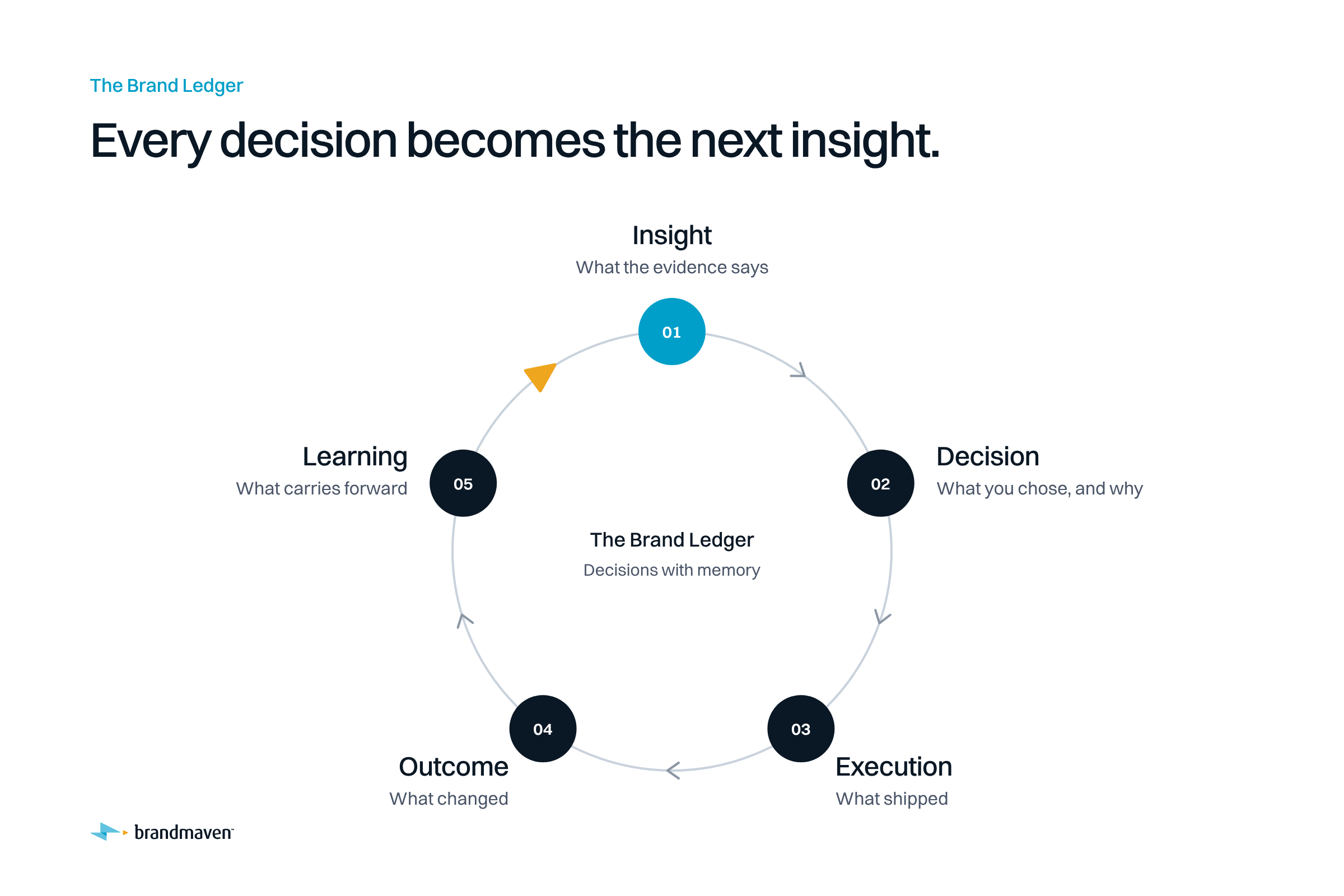
Insight → Decision → Execution → Outcome → Learning
This creates a system where brand strategy compounds over time instead of resetting.
Why This Matters More Than Ever
Brand has always been one of the most valuable and least structured assets in a company.
That's becoming a problem. As markets move faster and leadership turnover increases, companies are experiencing:
More frequent repositioning
- Shorter campaign cycles
- Increased pressure to prove impact
- Less continuity in strategic thinking
Without a system to capture and connect decisions, brand strategy becomes fragile. It depends too heavily on individuals. It lacks institutional memory. It struggles to evolve intelligently.
The Brand Ledger addresses this by making strategy durable.
A System That Thinks Over Time
The real value of a system of record is the history. The ability to look back and understand:
- What changed
- Who changed it
- Why they changed
- What worked
- What didn't
That's what the Brand Ledger enables. It turns brand strategy from a series of disconnected moments into a coherent, evolving system of decisions.
The Future of Brand Strategy
The future of brand management won't just be about better insights or faster recommendations. It will be about systems that remember, learn, and guide decisions over time.
The Brand Ledger is a step in that direction.
Not just helping you understand your brand. Not just helping you improve it. But helping you remember how you got there . . . and make smarter decisions because of it.