Why Brand Needs a Performance Layer Before It Gets a Brand Agent
Every week, a new headline announces that another function is getting its AI agent.
Finance has one. Operations has one. Sales has one. Customer service has several. The narrative is consistent and compelling: specialized AI agents, coordinated by a central orchestration layer, are going to transform how businesses run. Your future org chart will include both people and agents, each with defined responsibilities and measurable outputs.
It's a good story. And it's largely true. McKinsey describes this shift as hybrid human–agentic workforces where agents execute most of the work and humans design and oversee the network. The Canadian Marketing Association frames it as marketing moving from using AI as a tool to partnering with systems that autonomously understand, reason, and act. Google puts it plainly: agents are "things that do things".
But buried in the excitement is a question nobody is asking about brand: When your organization gets a Brand Agent, what will it actually know about your brand?
The Speed Problem Nobody Is Solving
Right now, the most urgent threat to brand is the speed gap: the widening distance between how fast brand-relevant decisions are being made and how equipped teams are to make them well.
Brand decisions aren't just happening in strategy sessions anymore. They're happening in every automated email sequence, every AI-generated ad variation, every product copy update, every sales enablement template. The volume and velocity of decisions that carry brand risk have grown dramatically and they're going to keep growing.
Most brand teams are trying to manage this with tools designed for a slower world: quarterly brand trackers, fragmented analytics, episodic research studies, and institutional memory stored in people's heads rather than systems.
This isn't a criticism of those teams. It's a structural gap. And it's about to get much worse.
What Happens When Agents Take Over Execution
As AI agents move into marketing operations and start managing campaign pacing, personalizing customer journeys, generating content variations, and optimizing bids, the pace of brand-relevant decisions will accelerate beyond what any human review process can keep up with.
That's not a reason to slow down on agents. The efficiency gains are real, and the competitive pressure to adopt them is already building. It's a reason to build the governance infrastructure first. As McKinsey notes from a year of agentic AI deployments, the challenge is operating model and governance, not raw model capabilities. Organizations must deconstruct workflows, define scopes, and set controls before agents get meaningful responsibility.
Here's the problem in plain terms: an agent executing a customer journey doesn't know what your brand stands for. It doesn't know that you've been deliberately positioning against a competitor on the dimension of simplicity. It doesn't know that last quarter you made a conscious decision to pull back on urgency-based messaging because it was eroding trust. It doesn't know your brand is in a sensitive moment following a product change.
An agent optimizes for what you tell it to optimize for. As Harvard Business Review suggests, what's required is a trusted, continuous, and structured source of brand intelligence (a performance layer). Without it, you're putting the fate of your brand into the hands to a system that has no real understanding of the asset it's operating on.
A Brand Agent Without a Performance Layer Is Just an Overconfident Copywriter
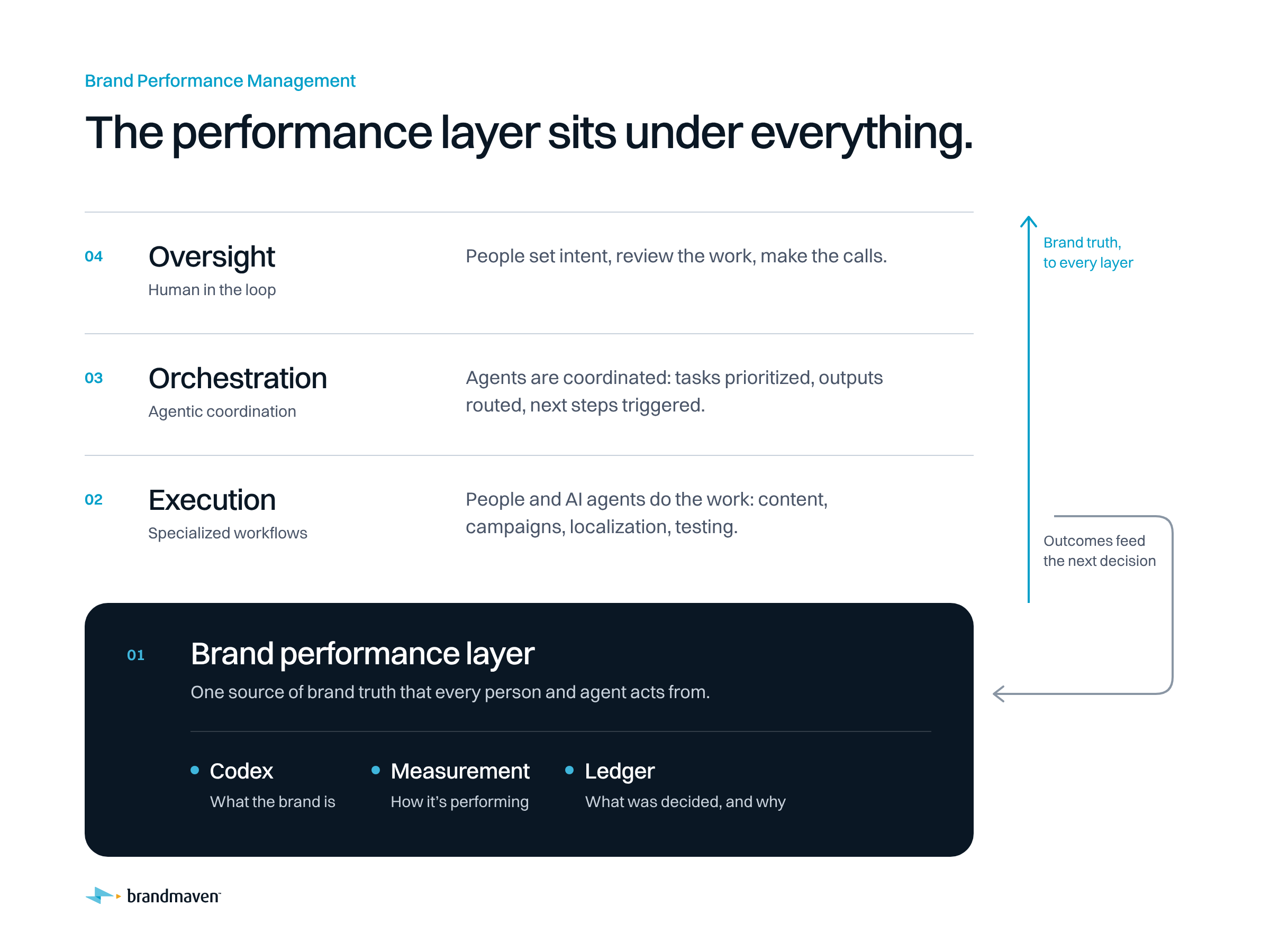
Think about what a Brand Agent will actually need to function responsibly. Not a chatbot that answers questions about your guidelines. Not an AI that generates on-brand copy. A genuine Brand Agent. One that monitors perception, detects drift, proposes strategic moves, and coordinates with other systems. I will need:
A machine-readable framework of business and brand rules. Agents need a frame of reference for positioning, messaging, tone of voice, customer insight, competitor insight, AI prompting guidelines . . . all kept up to date, not in a static PDF. This layer is essential as it governs how AI agents will make decisions, give human counterparts advice, and execute real work in the quality you demand.
A current, structured view of brand health. Not last quarter's tracker. A live read of how your brand is perceived across dimensions: clarity of message, distinctiveness, emotional resonance, competitive positioning. Brand performance is increasingly understood as multi-dimensional, spanning awareness, consideration, preference, loyalty, and associations. It needs continuous measurement tied to business outcomes, not annual snapshots. Brandmaven's Brand Health Monitoring tracks exactly these signals continuously, so agents and humans are always working from a current picture, not one that's six weeks stale.
Clear priorities and trade-offs. Brand performance isn't one-dimensional. You're always making trade-offs . . . growth versus consistency, broad awareness versus category ownership, short-term performance versus long-term equity. A Brand Agent needs to know which bets you're making and why, or it will optimize for the easiest metric at the expense of the right one.
A record of past decisions and the reasoning behind them. Organizations repeat brand mistakes not because they lack talent, but because context doesn't survive. When the team changes, when the agency rotates, when the CMO turns over, the institutional knowledge of what was tried, what worked, and why certain decisions were made, that all disappears. Brand Ledger was built precisely for this: preserving decision context so every future choice (human or agent) is made in full view of what came before.
Brand Performance Management is exactly that substrate. It's the operating layer that transforms brand from a set of guidelines and intuitions into a continuously maintained, decision-grade asset that both humans and agents can actually use. Read the full BPM framework →
A Solutions Consultant at a leading visual collaboration platform said it best after his first session:
"Brandmaven gave me what I needed before I knew how to ask for it."
That's not a feature description. That's what a performance layer actually does — it monitors, synthesizes, and surfaces brand intelligence continuously, so that when the moment arrives, you're already holding the answer.
BPM is Here.
The good news is that you don't need to wait for Brand Agents to exist before BPM starts delivering value. Organizations that implement a brand performance layer now get immediate, practical benefits:
Faster, more confident decisions in the moments that matter — repositioning conversations, crisis responses, campaign pivots, budget allocation debates. Instead of scrambling for data and alignment, you have a shared model that the whole team works from.
Clearer creative direction. When you know precisely where brand health is strong and where it's under pressure, briefs get sharper. Agencies spend less time guessing and more time solving the right problem.
Preserved decision history. The reasoning behind your brand choices becomes an organizational asset rather than a departing executive's memory.
And when your Brand Agent does arrive (when the orchestration platforms are mature, when the category has figured out what a Brand Agent actually does) you'll already have the performance layer it needs to operate responsibly. You won't be scrambling to build the foundation under a running system.
The Competitive Moat Is the Intelligence, Not the Agent
There's a pattern emerging across every domain where AI agents are being deployed: the organizations winning aren't the ones who moved fastest to deploy agents. They're the ones who had clean data, structured decision logic, and governed processes in place before the agents arrived.
Finance teams that built robust performance management systems over the past decade are deploying financial agents that actually work. Logistics organizations with mature operations data are running agent-driven optimization that compounds over time. The agent is only as good as the intelligence layer beneath it.
Brand is no different. Except that most organizations have invested less in governing brand as a performance asset than they have in governing almost any other function. Brand has largely been managed through intuition, relationships, and creativity. Those things matter enormously. They don't disappear in an agentic world.
But they need to be grounded in something more durable. A shared model of what brand performance actually means. Continuous visibility into where you are. A decision architecture that converts insight into action and records why.
That's the Brand Codex, a centralized brand framework that guides and governs agentic and human action. Start building yours today.