In 2020, Peloton's brand seemed unstoppable. Retention rates hit 95%+. NPS scores exceeded 70 (among the highest in fitness). Revenue soared 172%. Every operational metric pointed to brand success.
Then the pandemic subsided, and Peloton's brand positioning collapsed overnight. Were they a fitness company? A technology company? A luxury lifestyle brand? Wall Street couldn't tell. Customers couldn't tell. Revenue fell 90% in two years despite maintaining strong product satisfaction among existing users.
Peloton's crisis reveals a fundamental problem with how brands measure performance: The right operational data was measuring the wrong strategic question.
For decades, brand leaders have been asked to answer one deceptively complex question:
How is our brand actually performing?
The problem is not a lack of data. It’s that the wrong data has been used to answer the question.
- Awareness studies
- NPS scores
- Website analytics
- Social sentiment dashboards
Each tells part of the story. None tells the whole story.
That’s why we built the Brand Performance Index (BPI), a proprietary system designed to measure brand performance the way modern markets actually work. Visit the 2026 Q1 Brand Performance Index hub to review the index for 20+ industries.
Why Brand Measurement Is Broken
Traditional brand measurement evolved in an era where marketing channels were limited and customer journeys were predictable. Today’s reality looks very different:
- Buyers research anonymously
- AI systems influence discovery
- Competitors reposition constantly
- Reputation spreads across fragmented digital environments
- Brand perception shifts faster than quarterly reporting cycles.
Yet most organizations still rely on lagging indicators.
The Problem with Lagging Metrics for Brand Measurement
Metrics like awareness, NPS, and pipeline contribution are useful but incomplete. They suffer from three critical limitations:
1. They look backward
Awareness and NPS tell you what already happened, not what will happen next.
2. They isolate outcomes from causes
Pipeline may grow or shrink, but traditional measurement rarely explains why.
3. They fail to connect brand to operational decisions
Dashboards report performance without guiding action.
Brand leaders are left with data but no operating system for decision-making.
Why Brands Need a Composite Operating Metric
- Finance has composite metrics.
- Operations has composite metrics.
- Product teams have composite metrics.
Brand has historically had fragments.
The Brand Performance Index (BPI) introduces something brand organizations have never truly had: A composite operating metric for brand performance.
Rather than tracking isolated signals, BPI synthesizes dozens of inputs — website traffic, social media presence, customer reviews, media coverage, analyst commentary, industry publications, competitive positioning data, and customer loyalty indicators into a unified system that comprises:
- Market perception
- Competitive strength
- Strategic clarity
- Momentum
- Future growth potential
Think of it as a credit score for your brand, continuously updated, multi-dimensional, and tied to business outcomes.
What Is the Brand Performance Index?
The BPI evaluates brands across dozens of industries using seven core dimensions, producing both:
- Dimension-level performance scores
- An overall Brand Impact Score
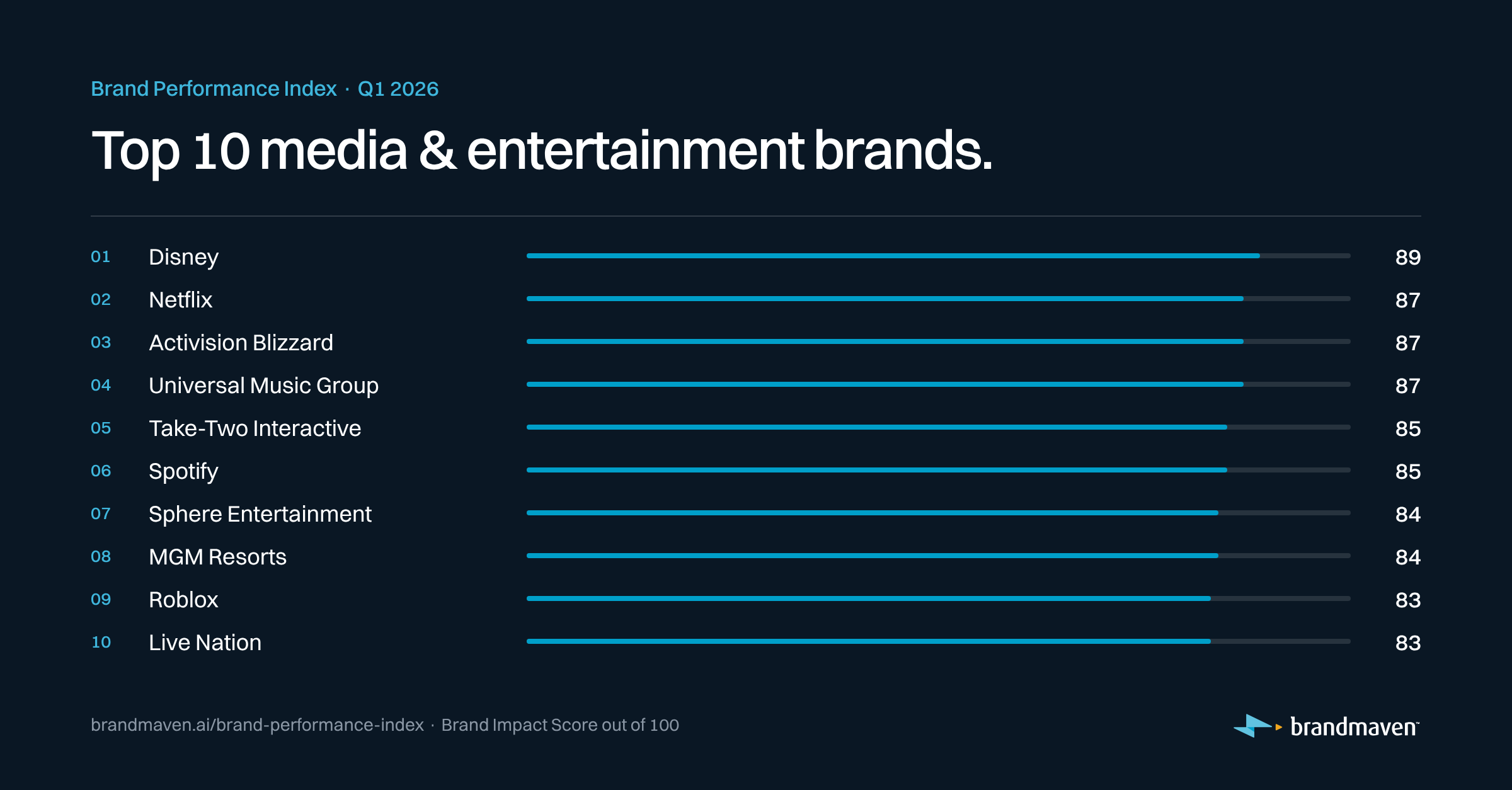
These scores allow organizations to benchmark themselves against competitors and understand where brand performance is accelerating or at risk.
The Seven Dimensions of Brand Performance
The BPI evaluates brand strength across seven interconnected dimensions. Together, they provide a complete picture of how a brand exists, competes, and grows in the market.
1. Market Awareness
Are you known by the right audiences?
Market Awareness measures how visible your brand is within its category and target market.
Signals include:
- Share of conversation
- Search and discovery visibility
- Media and analyst presence
- AI and digital discovery exposure
Business outcome:
Higher awareness expands consideration sets and increases the probability of inclusion early in buying journeys.
2. Perception
What do people believe about your brand?
Perception evaluates how audiences interpret and emotionally respond to your brand.
Signals include:
- Sentiment trends
- Trust indicators
- Reputation signals
- Customer and market commentary
Business outcome:
Positive perception improves conversion efficiency, strengthens credibility, and supports premium positioning.
3. Positioning Strength
Do you clearly stand for something different?
Positioning Strength measures how effectively your brand communicates a distinct and defensible market position.
Signals include:
- Narrative clarity
- Differentiation from competitors
- Value proposition consistency
- Category ownership signals
Business outcome:
Strong positioning reduces competitive friction and increases win rates by simplifying buyer decisions.
4. Consistency
Does your brand show up the same way everywhere?
Consistency evaluates how reliably your brand is expressed across channels, teams, and customer touchpoints.
Signals include:
- Messaging alignment across marketing and sales
- Visual and verbal coherence
- Cross-channel narrative continuity
- Internal brand adoption
Business outcome:
Consistent brands build memory structures faster, accelerate recognition, and prevent brand dilution caused by fragmented execution.
5. Loyalty
Do customers stay, advocate, and return?
Loyalty measures the strength of ongoing relationships between your brand and its customers.
Signals include:
- Repeat engagement patterns
- Advocacy behavior
- Customer retention indicators
- Community and referral momentum
Business outcome:
High loyalty reduces acquisition costs, increases lifetime value, and creates durable growth independent of paid demand generation.
6. Association
What ideas, values, and capabilities are linked to your brand?
Association evaluates the mental shortcuts audiences use when they think about your company.
Signals include:
- Category associations
- Attribute ownership (innovation, reliability, expertise, etc.)
- Problem-solution linkage
- AI-generated brand descriptions
Business outcome:
Strong associations ensure your brand is remembered for the *right reasons* — shaping consideration before buyers ever engage sales.
7. Market Influence
Does your brand shape the market — or react to it?
Market Influence measures a brand’s ability to lead conversations, define narratives, and move category direction.
Signals include:
- Thought leadership impact
- Narrative adoption by competitors
- Analyst and media amplification
- Share of strategic conversation
Business outcome:
Influential brands command attention, set pricing expectations, attract partners, and disproportionately capture growth opportunities.
Together, these seven dimensions transform brand measurement from isolated metrics into a holistic system for understanding brand power in motion, revealing not only where a brand stands today, but how it is likely to perform tomorrow.
The Brand Impact Score
Each dimension feeds into a single Brand Impact Score, a composite measurement reflecting overall brand performance. This score answers the question executives actually care about:
Is our brand strengthening or weakening our business?
Instead of debating disconnected metrics, leadership teams gain a shared operating view.
Curious about our methodology? Sign up for a free account for access to our complete Data Collection & Analysis Methodology.
The Future of Brand Measurement
The companies winning today invest in brand and operate it with discipline. They recognize that:
- Awareness alone doesn’t predict growth.
- NPS alone doesn’t guide strategy.
- Pipeline alone doesn’t explain market position.
Modern brand leadership requires a composite, forward-looking operating metric. That’s the role of the Brand Performance Index.